

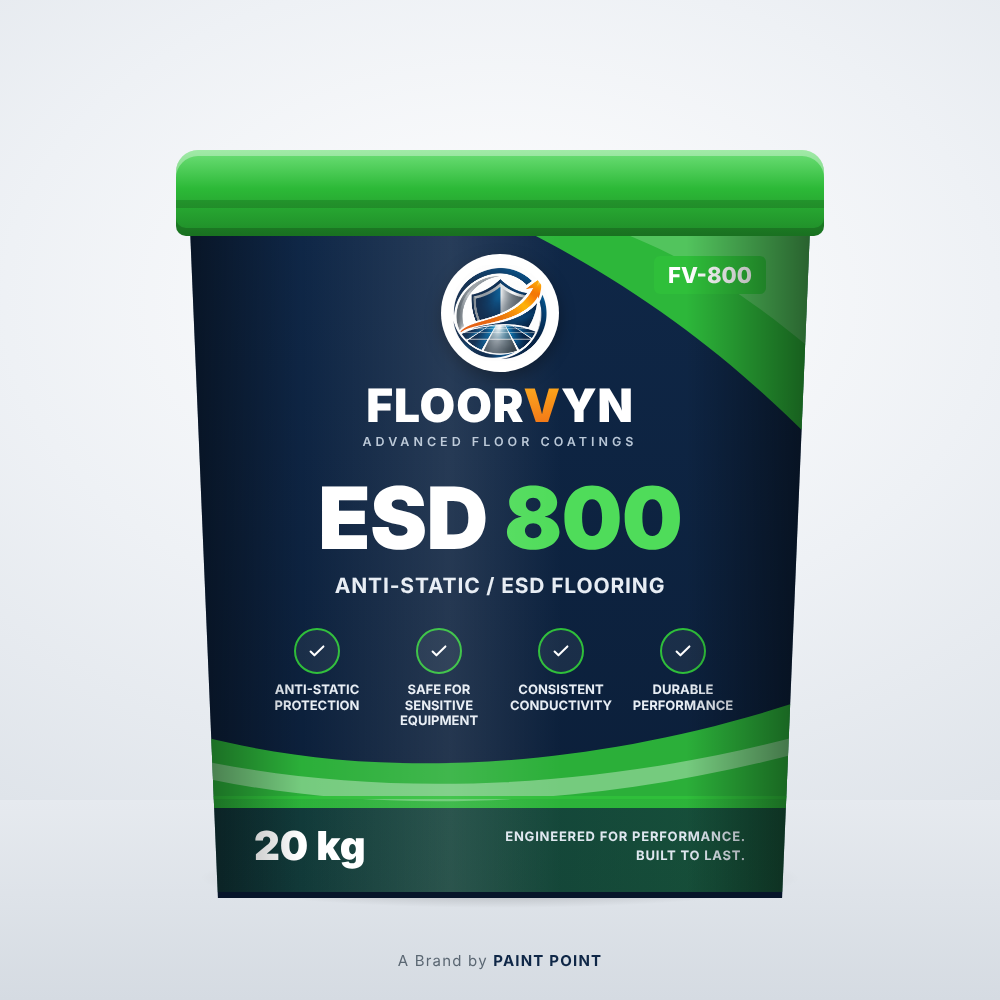
Floorvyn ESD 800 is an anti-static ESD flooring system built on a hard epoxy base. It carries static charge from people, trolleys and equipment safely to earth, which protects circuit boards, control panels and sensitive electronics from damage.
Why Your Site Needs ESD Flooring
A person walking across a normal floor can build up a static charge without feeling it. One touch is enough to damage a chip or upset a control system. ESD flooring gives that charge a controlled path to ground, so it never builds up in the first place.
Many electronics buyers and auditors now ask for ESD-safe areas, so this floor can also help with customer and quality requirements. Read more about electrostatic discharge.
Key Features
- Anti-static protection: controls static build-up across the floor.
- Safe for sensitive equipment: protects electronics and control systems.
- Consistent conductivity: even performance across the whole area.
- Durable performance: hard epoxy base for daily traffic.
- Joint-free: easy to clean and keep dust-free.
Where to Use ESD Flooring
- Electronics assembly and PCB units
- Server rooms and data centres
- Control rooms in power plants and factories
- Battery rooms and laboratories
For clean areas that do not need static control, SL 500 self-leveling epoxy is a simpler choice.
Surface Preparation
The slab is ground, repaired and primed with PRIME 100 epoxy floor primer. Copper earthing strips are then laid and connected to the building’s earth point, as designed for the area.
How It Is Applied
- Prime the prepared floor.
- Lay copper strips and connect them to earth points.
- Apply the conductive primer layer.
- Apply the ESD 800 top layer to the set thickness.
- Test resistance across the floor after curing.
Pack Size and Technical Data
ESD 800 is supplied as a 20 kg kit. Resistance values, coverage and application details are in the technical data sheet (TDS). For a site layout or earthing plan, WhatsApp us at 0332-8111360.
Planning an ESD Area
ESD flooring works as part of a wider static-control plan. The floor, earth points, ESD footwear and workstations all need to work together. We plan the copper strip layout and earth connections with your electrical team so the floor performs as expected.
Care and Maintenance
Clean with cleaners that are safe for ESD floors and avoid wax or polish, as these can block conductivity. Check resistance at regular intervals, especially in busy areas. Keep heavy dirt and rubber marks off the surface, as both can affect how well ESD flooring drains static.
Things to Check Before You Order
Share the room size, the type of equipment used and any resistance range your customer or standard requires. These details help us choose the right ESD flooring build-up and plan testing after installation.
Good to Know
Rubber-soled shoes, plastic chair wheels and some cleaning products can all affect how a static-control area performs. We share a short care sheet at handover listing what to use and what to avoid, so your team can keep the floor working properly. Regular resistance checks also give you a record for audits.
ESD Flooring FAQs
Is ESD flooring the same as normal epoxy?
No. It looks similar, but it contains conductive material and is connected to earth, so it controls static.
Do we still need ESD shoes?
For best results, yes. The floor and ESD footwear work together as one system.
Can ESD 800 go in a server room with raised floors?
It is used on the concrete slab or on solid floor areas. For raised floor systems, the tiles themselves need to be ESD rated.
Do you test the floor after installation?
Yes. We check resistance at points across the floor before handover. See our epoxy floor coating service page for the full process.
Share your room size and equipment type, and we will plan the right ESD system for you.





Reviews
There are no reviews yet.